The country’s water boards have submitted proposals to government seeking tariff increases to help meet operational costs and improve financial sustainability.
Two of the five water boards confirmed to Nation on Sunday submitting their proposals.
Blantyre Water Board (BWB) and Central Region Water Board (CRWB) cited rising operational expenses and mounting financial challenges as reasons for the proposed adjustments.
CRWB is seeking a 106 percent increase in water tariffs, arguing that the current pricing structure is inadequate to sustain its operations.
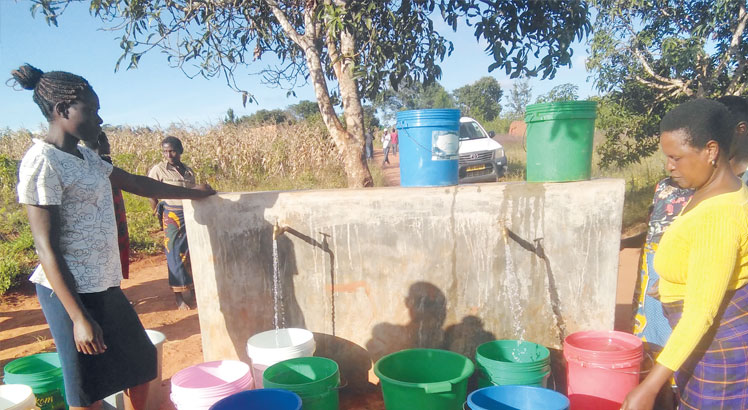
Chief executive officer Justin Kathumba said the utility’s financial analysis shows that under the current tariff structure, the board will continue operating at a significant loss.
He added that even a 65 percent tariff increase would not fully restore profitability.
Kathumba said the board would only begin generating sustainable surpluses when tariffs approach full cost recovery levels.
“It is important to note that tariff adjustment alone will not restore the board’s financial position. We are simultaneously implementing a comprehensive turnaround programme, with major interventions presented in the subsequent sections to ensure that customers benefit from improved service delivery while the board improves its financial sustainability. We recognise the need to balance affordability and cost recovery,” he said.
BWB chief executive officer Yeremia Chihana said in an interview that the utility is operating at a loss because current tariffs are not cost-reflective.
He said BWB spends approximately K4 500 to produce one cubic metre of water, but sells it at an average of K600.
Chihana said the board’s proposal for a 45 percent tariff increase has been submitted to the Ministry of Agriculture for approval although he remains uncertain about whether it will be implemented.
He also decried what he described as a lack of coordination among water boards in pushing for tariff hikes.
“As water boards, we do not have a strong case to make before the ministry. If we work collaboratively, we can push for it,” he said.
Parliament’s Budget and Finance Committee chairperson Sosten Gwengwe said the water boards should address their inefficiencies before seeking tariff increases.
He said the water boards are losing substantial income through non-revenue water (NRW) and operational inefficiencies, which if addressed, could save the utilities billions of kwacha and improve their financial position.
Officials figures show that water boards lose on average roughly a third of their pumped water to NRW largely arising from leakages due to old infrastructure, illegal connections and inaccurate billing, among others.
Gwengwe said though the water boards have not been allowed to increase tariffs over the past few years, the focus should first be on eliminating inefficiencies.
“Increasing the tariffs should be a case put forward after they have demonstrated they have done everything else in terms of cost reduction and maybe it’s really not translating into profit. But when there’s scope for efficiency, we are pushing for them to demonstrate efficiency and then we can help them argue for a moderate tariff adjustment,” he said.
Centre for Social Concern (CfSC) economic governance officer Agnes Nyirongo warned that higher tariffs would place an additional burden on households that depend on water boards as their primary source of water.
She said passing on the water board’s financial burden to consumers is unacceptable as the boards’ primary purpose is to serve Malawians with affordable and potable water than making profits.
“Prices of several commodities are already high. Another increase will make water unaffordable for many households. Lack of access could also create room for diseases such as cholera,” she said.
Apart from NRW, water boards also struggle with unpaid arrears, with the government itself being the major culprit.
For example, Public institutions owe CRWB board approximately K9.517 billion, of which K8.5 billion was owed by the Malawi Defence Force.
The arrears, according to authorities, have affected the board’s liquidity and its ability to meet operational obligations, undertake maintenance works and finance capital investments.
CRWB—which serves a population of more than 1.2 million people in nine districts of the Central Region that include Kasungu, Dowa, Salima and Dedza—recorded a loss of K1.6 billion in the 2024/25 financial year and another loss of K3 billion in the 2025/26 financial year.
On the other hand, BWB has recorded cumulative losses of K53.4 billion between 2023/24 and 2025/26 financial years and had a loan portfolio of K45.8 billion as of March 31, 2026, according to financial records sourced from the utility body.
It serves a population of over three million people in Blantyre and surrounding districts.
When contacted for a comment on the matter, Ministry of Agriculture and Water Development spokesperson Salome Gangire asked for more time to consult on the matter.
But in an earlier interview, Principal Secretary for Agriculture Erica Maganga said the focus is on water boards reducing their inefficiencies first before any tariff hikes.
When implementing tariff adjustments in June 2023, the water boards said the increases were justified by the 25 percent devaluation of the kwacha in May 2022 and the government’s failure to implement proposed tariff hikes in the previous financial year despite Cabinet approval.